

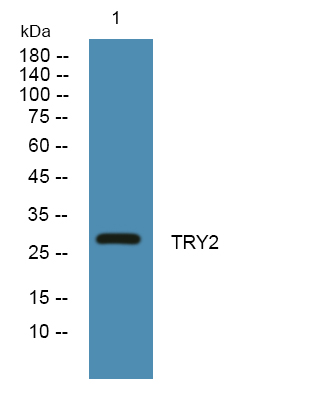
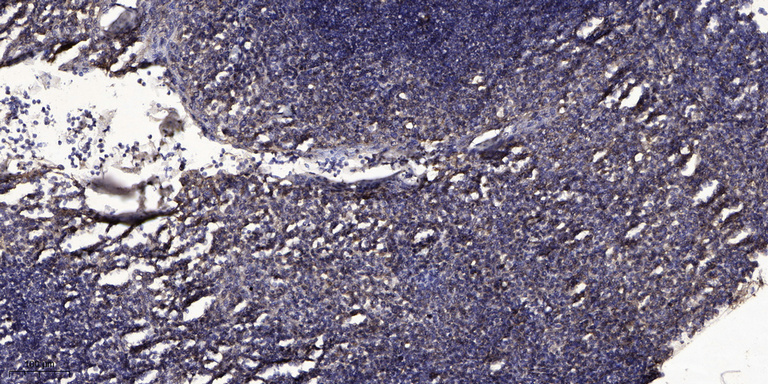
Main InformationTargetTRY2Host SpeciesRabbitReactivityHuman, Rat, Mouse,ApplicationsIHC, IF, WBMW27kD (Observed)Conjugate/ModificationUnmodifiedDetailed InformationRecommended Dilution RatioIHC 1:50-200; WB 1:500-2000; IF 1:50-200FormulationLiquid in PBS containing 50% glycerol, 0.5% BSA and 0.02% sodium azide.SpecificityThis antibody detects endogenous levels of human TRY2PurificationThe antibody was affinity-purified from rabbit antiserum by affinity-chromatography using epitope-specific immunogen.Storage-15°C to -25°C/1 year(Do not lower than -25°C)Concentration1 mg/mlMW(Observed)27kDModificationUnmodifiedClonalityPolyclonalIsotypeIgGAntigen&Target InformationImmunogen:Synthesized peptide derived from human TRY2Specificity:This antibody detects endogenous levels of human TRY2Gene Name:PRSS2 TRY2 TRYP2Protein Name:TRY2Other Name:Trypsin-2 ; Anionic trypsinogen ; Serine protease 2 ; Trypsin II ;Background:This gene belongs to the trypsin family of serine proteases and encodes anionic trypsinogen. It is part of a cluster of trypsinogen genes that are located within the T cell receptor beta locus. Enzymes of this family cleave peptide bonds that follow lysine or arginine residues. This protein is found at high levels in pancreatic juice and its upregulation is a characteristic feature of pancreatitis. This protein has also been found to activate pro-urokinase in ovarian tumors, suggesting a function in tumor invasion. In addition, this enzyme is able to cleave across the type II collagen triple helix in rheumatoid arthritis synovitis tissue, potentially participating in the degradation of type II collagen-rich cartilage matrix. Alternative splicing results in multiple transcript variants.[provided by RefSeq, Jan 2015],Function:Catalytic activity:Preferential cleavage: Arg-|-Xaa, Lys-|-Xaa.,cofactor:Binds 1 calcium ion per subunit.,PTM:Sulfated on tyrosine.,similarity:Belongs to the peptidase S1 family.,similarity:Contains 1 peptidase S1 domain.,Cellular Localization:Secreted, extracellular space.Tissue Expression:Expressed in Paneth cells, at the base of small intestinal crypts.Research Areas:>>Neuroactive ligand-receptor interaction ; >>Pancreatic secretion ; >>Protein digestion and absorption ; >>Influenza A
商品信息已成功复制,启研竭诚为您服务


