

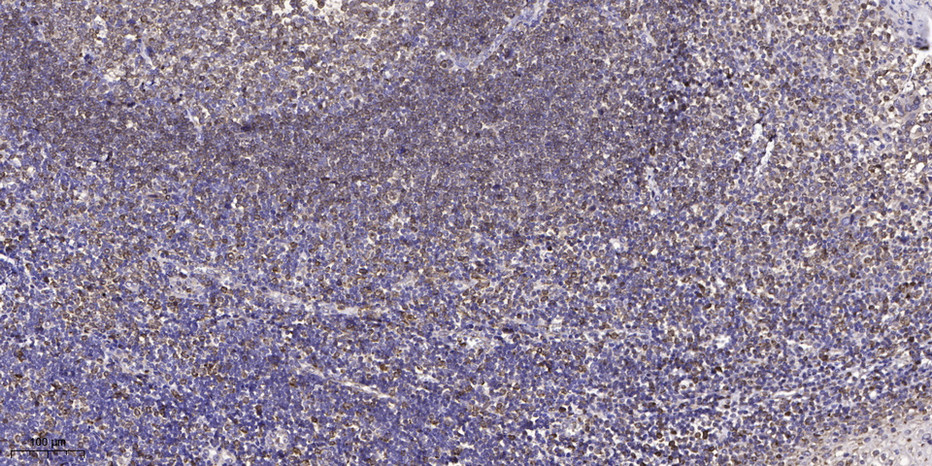
Main InformationTargetGNG4Host SpeciesRabbitReactivityHuman, MouseApplicationsIHC, ELISAConjugate/ModificationUnmodifiedDetailed InformationRecommended Dilution RatioIHC 1:50-200; ELISA(peptide)1:5000-20000FormulationLiquid in PBS containing 50% glycerol, 0.5% BSA and 0.02% sodium azide.SpecificityThis antibody detects endogenous levels of human GNG4PurificationThe antibody was affinity-purified from rabbit antiserum by affinity-chromatography using epitope-specific immunogen.Storage-15°C to -25°C/1 year(Do not lower than -25°C)Concentration1 mg/mlModificationUnmodifiedClonalityPolyclonalIsotypeIgGAntigen&Target InformationImmunogen:Synthesized peptide derived from human GNG4 AA range: 1-50Specificity:This antibody detects endogenous levels of human GNG4Gene Name:GNG4 GNGT4Protein Name:GNG4Other Name:Guanine nucleotide-binding protein G ; I ; /G ; S ; /G ; O ; subunit gamma-4Background:function:Guanine nucleotide-binding proteins (G proteins) are involved as a modulator or transducer in various transmembrane signaling systems. The beta and gamma chains are required for the GTPase activity, for replacement of GDP by GTP, and for G protein-effector interaction.,similarity:Belongs to the G protein gamma family.,subunit:G proteins are composed of 3 units, alpha, beta and gamma. Interacts with beta-1 and beta-2, but not with beta-3.,tissue specificity:Brain, kidney, pancreas, skeletal muscle and faintly in cardiac muscle.,Function:Function:Guanine nucleotide-binding proteins (G proteins) are involved as a modulator or transducer in various transmembrane signaling systems. The beta and gamma chains are required for the GTPase activity, for replacement of GDP by GTP, and for G protein-effector interaction.,similarity:Belongs to the G protein gamma family.,subunit:G proteins are composed of 3 units, alpha, beta and gamma. Interacts with beta-1 and beta-2, but not with beta-3.,tissue specificity:Brain, kidney, pancreas, skeletal muscle and faintly in cardiac muscle.,Cellular Localization:Cell membrane ; Lipid-anchor ; Cytoplasmic side .Tissue Expression:Brain, kidney, pancreas, skeletal muscle and faintly in cardiac muscle.Research Areas:>>Ras signaling pathway ; >>Chemokine signaling pathway ; >>PI3K-Akt signaling pathway ; >>Apelin signaling pathway ; >>Circadian entrainment ; >>Retrograde endocannabinoid signaling ; >>Glutamatergic synapse ; >>Cholinergic synapse ; >>Serotonergic synapse ; >>GABAergic synapse ; >>Dopaminergic synapse ; >>Relaxin signaling pathway ; >>Morphine addiction ; >>Alcoholism ; >>Human cytomegalovirus infection ; >>Kaposi sarcoma-associated herpesvirus infection ; >>Human immunodeficiency virus 1 infection ; >>Pathways in cancer
商品信息已成功复制,启研竭诚为您服务


