

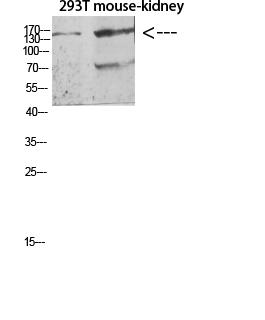
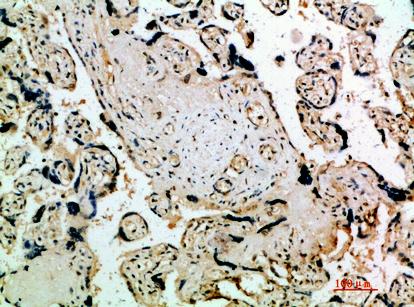
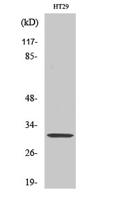
Target:VEGFR3
Fields:MAPK signaling pathway;Ras signaling pathway;Rap1 signaling pathway;Calcium signaling pathway;PI3K-Akt signaling pathway;Focal adhesion;Pathways in cancer;Breast cancer
Gene Name:FLT4 VEGFR3
Protein Name:Vascular endothelial growth factor receptor 3 (VEGFR-3) (EC 2.7.10.1) (Fms-like tyrosine kinase 4) (FLT-4) (Tyrosine-protein kinase receptor FLT4)
Human Gene Id:2324
Human Swiss Prot No:P35916
Mouse Gene Id:14257
Mouse Swiss Prot No:P35917
Rat Swiss Prot No:Q91ZT1
Immunogen:Synthetic peptide from human protein at AA range: 640-700
Specificity:The antibody detects endogenous Flt-4
Formulation:Liquid in PBS containing 50% glycerol, 0.5% BSA and 0.02% sodium azide.
Source:Polyclonal, Rabbit,IgG
Dilution:WB 1:500-2000,IHC 1:500-200, ELISA 1:10000-20000. IF 1:50-200
Purification:The antibody was affinity-purified from rabbit antiserum by affinity-chromatography using epitope-specific immunogen.
Concentration:1 mg/ml
Storage Stability:-15°C to -25°C/1 year(Do not lower than -25°C)
Other Name:Vascular endothelial growth factor receptor 3 (VEGFR-3;EC 2.7.10.1;Fms-like tyrosine kinase 4;FLT-4;Tyrosine-protein kinase receptor FLT4)
Observed Band(KD):170kD
Background: This gene encodes a tyrosine kinase receptor for vascular endothelial growth factors C and D. The protein is thought to be involved in lymphangiogenesis and maintenance of the lymphatic endothelium. Mutations in this gene cause hereditary lymphedema type IA. [provided by RefSeq, Jul 2008],
Function:catalytic activity:ATP + a [protein]-L-tyrosine = ADP + a [protein]-L-tyrosine phosphate.,disease:Defects in FLT4 are found in juvenile hemangioma. Juvenile hemangiomas are the most common tumors of infancy, occurring as many as 10% of all births. These benign vascular lesions enlarge rapidly during the first year of life by hyperplasia of endothelial cells and attendant pericytes, and then spontaneously involute over a period of years, leaving loose fibrofatty tissue.,disease:Defects in FLT4 are the cause of lymphedema hereditary type 1 (LYH1A) [MIM:153100]; also known as Nonne-Milroy lymphedema or Milroy disease. Hereditary lymphedema is a chronic disabling condition which results in swelling of the extremities due to altered lymphatic flow. Patients with lymphedema suffer from recurrent local infections and physical impairment.,function:Receptor for VEGFC. Has a tyrosine-protein kinas
Subcellular Location:Cell membrane ; Single-pass type I membrane protein. Cytoplasm . Nucleus . Ligand-mediated autophosphorylation leads to rapid internalization. .; [Isoform 1]: Cell membrane; Single-pass type I membrane protein. Ligand-mediated autophosphorylation leads to rapid internalization.; [Isoform 2]: Cell membrane; Single-pass type I membrane protein.; [Isoform 3]: Secreted. Cytoplasm.
Expression:Detected in endothelial cells (at protein level). Widely expressed. Detected in fetal spleen, lung and brain. Detected in adult liver, muscle, thymus, placenta, lung, testis, ovary, prostate, heart, and kidney.
商品信息已成功复制,启研竭诚为您服务


