

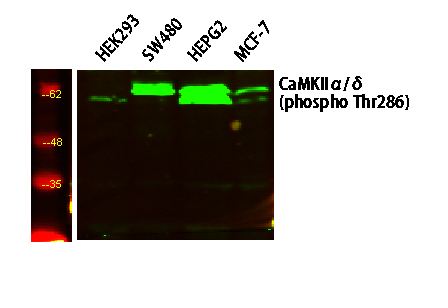
Main InformationTargetCaMK2Host SpeciesRabbitReactivityHuman, Mouse, RatApplicationsWB, ELISAMW54kD (Observed)Conjugate/ModificationPhosphoDetailed InformationRecommended Dilution RatioWB 1:500-2000; ELISA(peptide)1:5000-20000FormulationLiquid in PBS containing 50% glycerol, 0.5% BSA and 0.02% sodium azide.SpecificityThis antibody detects endogenous pospho levels of human CaMK2 (Phospho-Thr286)PurificationThe antibody was affinity-purified from mouse ascites by affinity-chromatography using specific immunogen.Storage-15°C to -25°C/1 year(Do not lower than -25°C)Concentration1 mg/mlMW(Observed)54kDModificationPhosphoClonalityPolyclonalIsotypeIgGAntigen&Target InformationImmunogen:Synthesized pospho peptide derived from human CaMK2 (Phospho-Thr286)Specificity:This antibody detects endogenous pospho levels of human CaMK2 (Phospho-Thr286)Gene Name:CAMK2D CAMKDProtein Name:CaMK2 (Phospho-Thr286)Other Name:Calcium/calmodulin-dependent protein kinase type II subunit delta ; CaM kinase II subunit delta ; CaMK-II subunit delta ;Background:The product of this gene belongs to the serine/threonine protein kinases family, and to the Ca(2+)/calmodulin-dependent protein kinases subfamily. Calcium signaling is crucial for several aspects of plasticity at glutamatergic synapses. This calcium calmodulin-dependent protein kinase is composed of four different chains: alpha, beta, gamma, and delta. The alpha chain encoded by this gene is required for hippocampal long-term potentiation (LTP) and spatial learning. In addition to its calcium-calmodulin (CaM)-dependent activity, this protein can undergo autophosphorylation, resulting in CaM-independent activity. Two transcript variants encoding distinct isoforms have been identified for this gene. [provided by RefSeq, Nov 2008],Function:Catalytic activity:ATP + a protein = ADP + a phosphoprotein.,enzyme regulation:Autophosphorylation of Thr-286 allows the kinase to switch from a calmodulin-dependent to a calmodulin-independent state.,Function:CaM-kinase II (CAMK2) is a prominent kinase in the central nervous system that may function in long-term potentiation and neurotransmitter release. Member of the NMDAR signaling complex in excitatory synapses it may regulate NMDAR-dependent potentiation of the AMPAR and synaptic plasticity.,similarity:Belongs to the protein kinase superfamily.,similarity:Belongs to the protein kinase superfamily. CAMK Ser/Thr protein kinase family. CaMK subfamily.,similarity:Contains 1 protein kinase domain.,subcellular location:Postsynaptic lipid rafts.,subunit:CAMK2 is composed of four different chains: alpha, beta, gamma, and delta. The different isoforms assemble into homo- or heteromultimeric holoenzymes composed of 8 to 12 subunits. Interacts with BAALC, MPDZ, SYN1, CAMK2N2 and SYNGAP1.,Cellular Localization:Cell junction, synapse . Cell junction, synapse, postsynaptic density . Cell projection, dendritic spine . Cell projection, dendrite . Postsynaptic lipid rafts. .Tissue Expression:Brain,Research Areas:>>ErbB signaling pathway ; >>Calcium signaling pathway ; >>cAMP signaling pathway ; >>HIF-1 signaling pathway ; >>Oocyte meiosis ; >>Necroptosis ; >>Adrenergic signaling in cardiomyocytes ; >>Wnt signaling pathway ; >>Axon guidance ; >>Circadian entrainment ; >>Long-term potentiation ; >>Neurotrophin signaling pathway ; >>Cholinergic synapse ; >>Dopaminergic synapse ; >>Olfactory transduction ; >>Inflammatory mediator regulation of TRP channels ; >>Insulin secretion ; >>GnRH signaling pathway ; >>Melanogenesis ; >>Oxytocin signaling pathway ; >>Glucagon signaling pathway ; >>Aldosterone synthesis and secretion ; >>Cushing syndrome ; >>Gastric acid secretion ; >>Parkinson disease ; >>Pathways of neurodegeneration - multiple diseases ; >>Amphetamine addiction ; >>Tuberculosis ; >>Pathways in cancer ; >>Proteoglycans in cancer ; >>Glioma ; >>Diabetic cardiomyopathy ; >>Lipid and atherosclerosis
商品信息已成功复制,启研竭诚为您服务


