

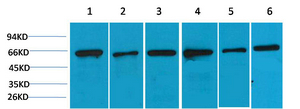
Main InformationTargetAMPKα2Host SpeciesRabbitReactivityHuman, Mouse, RatApplicationsWBMW62kD (Observed)Conjugate/ModificationUnmodifiedDetailed InformationRecommended Dilution RatioWB 1:1000-2000FormulationPBS, pH 7.4, containing 0.5%BSA, 0.02% sodium azide as Preservative and 50% Glycerol.SpecificityThe antibody detects endogenous AMPKα2 protein.PurificationThe antibody was affinity-purified from rabbit antiserum by affinity-chromatography using epitope-specific immunogen.Storage-15°C to -25°C/1 year(Do not lower than -25°C)MW(Observed)62kDModificationUnmodifiedClonalityPolyclonalIsotypeIgGAntigen&Target InformationImmunogen:Recombinant Protein of AMPKα2Specificity:The antibody detects endogenous AMPKα2 protein.Gene Name:PRKAA2Protein Name:5'-AMP-activated protein kinase catalytic subunit alpha-2Other Name:PRKAA2 ; AMPK ; AMPK2 ; 5'-AMP-activated protein kinase catalytic subunit alpha-2 ; AMPK subunit alpha-2 ; Acetyl-CoA carboxylase kinase ; ACACA kinase ; Hydroxymethylglutaryl-CoA reductase kinase ; HMGCR kinaseBackground:The protein encoded by this gene is a catalytic subunit of the AMP-activated protein kinase (AMPK). AMPK is a heterotrimer consisting of an alpha catalytic subunit, and non-catalytic beta and gamma subunits. AMPK is an important energy-sensing enzyme that monitors cellular energy status. In response to cellular metabolic stresses, AMPK is activated, and thus phosphorylates and inactivates acetyl-CoA carboxylase (ACC) and beta-hydroxy beta-methylglutaryl-CoA reductase (HMGCR), key enzymes involved in regulating de novo biosynthesis of fatty acid and cholesterol. Studies of the mouse counterpart suggest that this catalytic subunit may control whole-body insulin sensitivity and is necessary for maintaining myocardial energy homeostasis during ischemia. [provided by RefSeq, Jul 2008],Function:Catalytic activity:ATP + a protein = ADP + a phosphoprotein.,cofactor:Magnesium.,enzyme regulation:Binding of AMP results in allosteric activation, inducing phosphorylation on Thr-172 by STK11 in complex with STE20-related adapter-alpha (STRAD alpha) pseudo kinase and CAB39. Also activated by phosphorylation by CAMKK2 triggered by a rise in intracellular calcium ions, without detectable changes in the AMP/ATP ratio.,Function:Responsible for the regulation of fatty acid synthesis by phosphorylation of acetyl-CoA carboxylase. It also regulates cholesterol synthesis via phosphorylation and inactivation of hormone-sensitive lipase and hydroxymethylglutaryl-CoA reductase. Appears to act as a metabolic stress-sensing protein kinase switching off biosynthetic pathways when cellular ATP levels are depleted and when 5'-AMP rises in response to fuel limitation and/or hypoxia. This is a catalytic subunit.,similarity:Belongs to the protein kinase superfamily. CAMK Ser/Thr protein kinase family. SNF1 subfamily.,similarity:Contains 1 protein kinase domain.,subunit:Heterotrimer of a catalytic subunit, a beta and a gamma non-catalytic subunits.,Cellular Localization:Cytoplasm . Nucleus . In response to stress, recruited by p53/TP53 to specific promoters. .Tissue Expression:Heart,Skeletal muscle,Research Areas:>>FoxO signaling pathway ; >>Autophagy - animal ; >>mTOR signaling pathway ; >>PI3K-Akt signaling pathway ; >>AMPK signaling pathway ; >>Longevity regulating pathway ; >>Longevity regulating pathway - multiple species ; >>Apelin signaling pathway ; >>Tight junction ; >>Circadian rhythm ; >>Thermogenesis ; >>Insulin signaling pathway ; >>Adipocytokine signaling pathway ; >>Oxytocin signaling pathway ; >>Glucagon signaling pathway ; >>Insulin resistance ; >>Non-alcoholic fatty liver disease ; >>Alcoholic liver disease ; >>Hypertrophic cardiomyopathy ; >>Fluid shear stress and atherosclerosis
商品信息已成功复制,启研竭诚为您服务


