

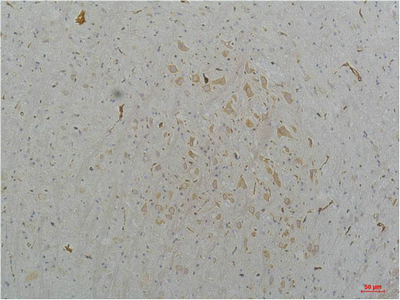
Main InformationTargetCav2.2Host SpeciesRabbitReactivityHuman, Rat, MouseApplicationsIHC, IFMW263kD (Observed)Conjugate/ModificationUnmodifiedDetailed InformationRecommended Dilution RatioIHC 1:50-100; IF 1:50-200FormulationLiquid in PBS containing 50% glycerol, 0.5% BSA and 0.02% sodium azide.SpecificityCav2.2 protein(A205) detects endogenous levels of Cav2.2PurificationThe antibody was affinity-purified from rabbit antiserum by affinity-chromatography using epitope-specific immunogen.Storage-15°C to -25°C/1 year(Do not lower than -25°C)Concentration1 mg/mlMW(Observed)263kDModificationUnmodifiedClonalityPolyclonalIsotypeIgGAntigen&Target InformationImmunogen:Synthetic Peptide of Cav2.2 AA range: 230-310Specificity:Cav2.2 protein(A205) detects endogenous levels of Cav2.2Gene Name:CACNA1BProtein Name:Voltage-dependent N-type calcium channel subunit alpha-1B (Brain calcium channel III) (BIII) (Calcium channel, L type, alpha-1 polypeptide isoform 5) (Voltage-gated calcium channel subunit alpha Cav2.2)Other Name:Voltage-dependent N-type calcium channel subunit alpha-1B ; Brain calcium channel III ; BIII ; Calcium channel, L type, alpha-1 polypeptide isoform 5 ; Voltage-gated calcium channel subunit alpha Cav2.2 ;Background:calcium voltage-gated channel subunit alpha1 B(CACNA1B) Homo sapiens The protein encoded by this gene is the pore-forming subunit of an N-type voltage-dependent calcium channel, which controls neurotransmitter release from neurons. The encoded protein forms a complex with alpha-2, beta, and delta subunits to form the high-voltage activated channel. This channel is sensitive to omega-conotoxin-GVIA and omega-agatoxin-IIIA but insensitive to dihydropyridines. Two transcript variants encoding different isoforms have been found for this gene. [provided by RefSeq, Aug 2011],Function:Domain:Each of the four internal repeats contains five hydrophobic transmembrane segments (S1, S2, S3, S5, S6) and one positively charged transmembrane segment (S4). S4 segments probably represent the voltage-sensor and are characterized by a series of positively charged amino acids at every third position.,Function:Voltage-sensitive calcium channels (VSCC) mediate the entry of calcium ions into excitable cells and are also involved in a variety of calcium-dependent processes, including muscle contraction, hormone or neurotransmitter release, gene expression, cell motility, cell division and cell death. The isoform alpha-1B gives rise to N-type calcium currents. N-type calcium channels belong to the 'high-voltage activated' (HVA) group and are blocked by omega-conotoxin-GVIA (omega-CTx-GVIA) and by omega-agatoxin-IIIA (omega-Aga-IIIA). They are however insensitive to dihydropyridines (DHP), and omega-agatoxin-IVA (omega-Aga-IVA). Calcium channels containing alpha-1B subunit may play a role in directed migration of immature neurons.,PTM:Phosphorylated in vitro by CaM-kinase II, PKA, PKC and CGPK.,similarity:Belongs to the calcium channel alpha-1 subunit (TC 1.A.1.11) family.,similarity:Contains 1 EF-hand domain.,subunit:Multisubunit complex consisting of alpha-1, alpha-2, beta and delta subunits in a 1:1:1:1 ratio. The channel activity is directed by the pore-forming and voltage-sensitive alpha-1 subunit. In many cases, this subunit is sufficient to generate voltage-sensitive calcium channel activity. The auxiliary subunits beta and alpha-2/delta linked by a disulfide bridge regulate the channel activity. Interacts with RIMS1 and RIMBP2.,tissue specificity:Isoform Alpha-1b-1 and isoform Alpha-1b-2 are expressed in the central nervous system, but not in skeletal muscle or aorta.,Cellular Localization:Membrane ; Multi-pass membrane protein .Tissue Expression:Isoform Alpha-1b-1 and isoform Alpha-1b-2 are expressed in the central nervous system, but not in skeletal muscle or aorta. Expressed in the cerebral white matter, cortex, hippocampus, basal ganglia, and cerebellum (PubMed:30982612).Research Areas:>>MAPK signaling pathway ; >>Calcium signaling pathway ; >>Synaptic vesicle cycle ; >>Retrograde endocannabinoid signaling ; >>Cholinergic synapse ; >>Serotonergic synapse ; >>GABAergic synapse ; >>Dopaminergic synapse ; >>Type II diabetes mellitus ; >>Huntington disease ; >>Prion disease ; >>Pathways of neurodegeneration - multiple diseases ; >>Morphine addiction ; >>Nicotine addiction ; >>Chemical carcinogenesis - receptor activation
商品信息已成功复制,启研竭诚为您服务


